The briefing paper highlighted today was produced by the Korea Institute for International Economic Policy and is a good summary of where China is today. It flags the major outstanding issues and, where possible, what can be done about them.
The blue line below is the Incremental Capital Output Ratio (ICOR) or how much has to be put in to get something out. Its plain, this has been a one-way street for a long time and there’s probably no reversing it. It goes with the territory of being better developed. A city with no subway lines benefits a lot from one, but by line #10 benefits really thin out.
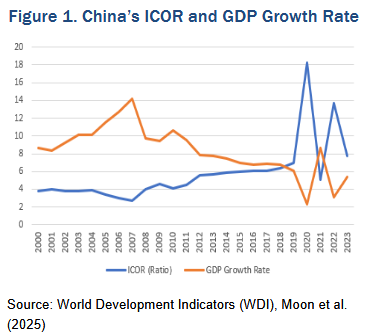
The government are directing investment away from the old-stuff-that-worked towards the new-stuff-that-works but the paper wonders if the private sector wouldn’t do a better job?
Demographics are another well understood problem but the chart always makes me shudder. The two lines show a wide discrepancy depending on how you like your data but either way the trend is brutal.
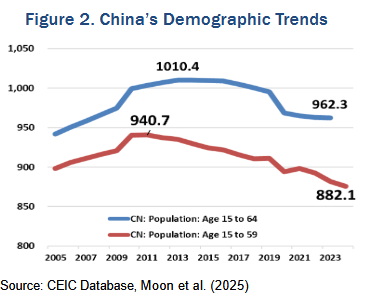
Again there’s policy response. Child-birth incentives, pushing out retirement ages and retraining programs among them but the problem is a global/societal one so these responses probably won’t move the needle much.
Finally, there’s the Total Factor Productivity (TFP) drop, however and whoever counts this, it seems deeply baked-in. The trend seems to have accelerated from around the time of the GFC. That’s when China last pumped the stimulus pedal hard if you remember? .
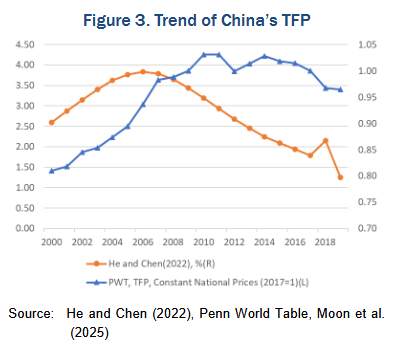
This chart suggests resource misallocation and doubtless planners are aware. So far though they seem to have been unable to right this. Technology and investment into ‘new productive forces’ are the right way to go, but these things have long lead times before benefits will be felt.
Looking further out, however you shake the models, growth appears to flame out in around 2050 or in just 25-years time.
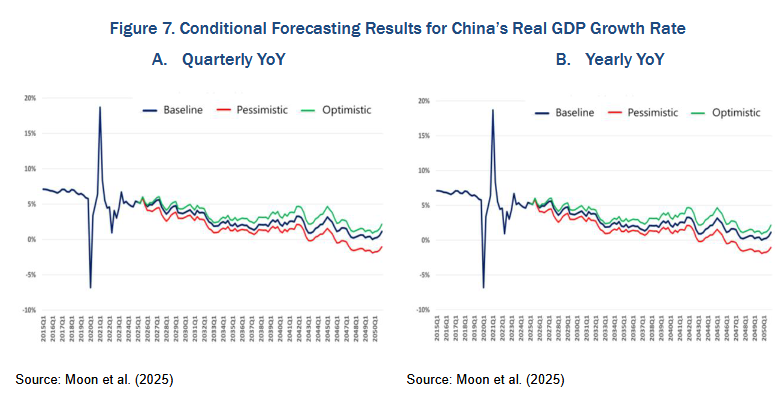
The paper concludes; “..Korea should adopt a strategic, three-pronged approach—preemptive policy and institutional management, the building of international cooperation safety nets, and the strengthening of domestic industrial resilience—across the policy, market, and institutional domains.”
Which they should; and I’m sure we all wish them good luck with that.
You can read the paper in full via this link China’s Growth in Transition.
Happy Sunday.