Catalina Cozariuc of the European University Institute (Florence, Italy) together with Luc Laeven and Alexander A. Popov of the European Central Bank provide a companion piece to last week’s paper on how China can/will develop as an educational powerhouse.
Key to achieving educational-superpower status China will need to crank up it’s output of peer-reviewed and published scientific papers. In the work looked over this week researchers investigate the track record from 2006.
Why 2006? It was that year China adopted the ‘National Medium- and
Long-Term Plan for the Development of Science and Technology (NMLP)’ i.e. decided to make academic research output a priority. The areas for focus were physics, chemistry, biology and medicine. Mathematics and economics were passed over in this process.
In 2022 China overtook the United States as the largest producer of scientific publications so I it seems the NMLP worked. This is an interesting result for two reasons:
First, before this initiative many would have been skeptical that government spending would lead so reliably to academic excellence. Second, the fact this policy has worked provides a template for other nations, developing and otherwise, on how to boost their own academic complexes.
As mathematics and economics were omitted from the initiative it’s possible to quantify just how effective the policy has been with regard to these ‘dummy’ variables.
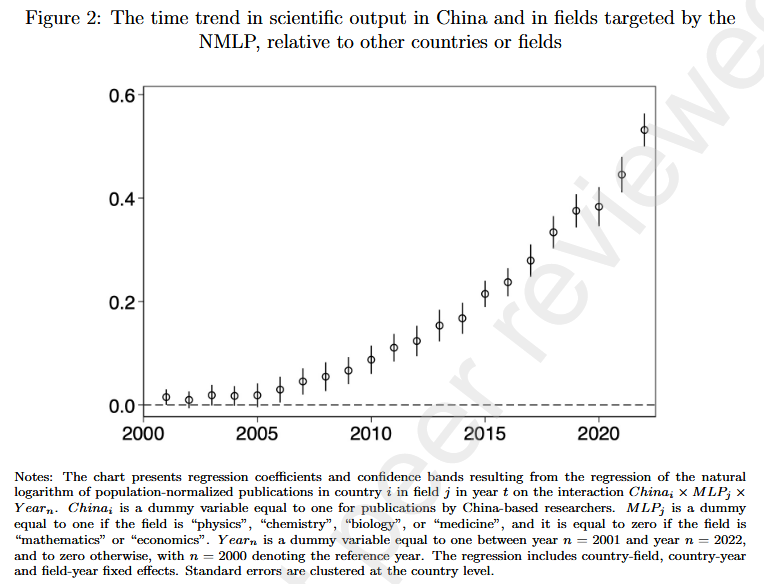
Results again speak for themselves. It’s not only the focus on output-total that’s important but the focus on the subjects chosen that’s visibly made a difference. The researchers note also China’s gain reflects a relative slide in both European and U.S. contributions which may have contributed to unease in both places about China’s rise in general.
They conclude noting the absence of progress in economics* and wonder if good performance in other areas to date can be continued given the ageing population and ambient trade tensions?
[*So NOT a science, IMHO. Science is dropping water into sulfuric acid, stand back! Always. Economics? If interest rates go up asset prices should go down, except when they don’t, which is quite often.]
My two pennyworth would be to note these sorts of trends tend to establish centripetal momentum and are very likely to continue.
You can read the paper in full via the following link The Rise of China in Academic Research.
Happy Sunday.