Justin Ko, Harvard Law School; University of Macau, Faculty of Law, Students, takes a closer look at three of the most successful Chinese EV companies (of 115 now operating) and tries to explain what separates the leaders from the rest.
He starts by reminding that much analysis from the West on China’s EV market is just plain wrong. It’s not a monolith controlled by an all-seeing China Inc. In the space there are foreign operated companies (Tesla), JVs (Volkswagen-SAIC), SOEs (SAIC) and private startups (Li Auto, Xpeng). It makes little sense therefore for foreign governments to impose blanket sanctions as they have done.
On the issue of subsidies, these exist but no single player is getting the same benefit as a peer which explains the cutthroat competition that characterizes the market today.
Moreover, that competition isn’t a market out of control. The bully-on-the-block, BYD, has led prices down to try and fry off competitors. It can do this because its profitable and not splurging government largess in the process.
The ’puzzle’ in the title refers to the conundrum of Western observers trying to explain what they characterize as a rigged, subsidized and manipulated market where some companies like BYD, Geely and Xiomi are cutting a dash when over 100+ competitors are not? To answer the puzzle the paper gives us snapshots of what makes the dash-cutters so.
BYD. Most are aware this grew out of a battery maker. Fewer are aware it makes 75% of its other components in house. This gives it significant cost advantages by not having to pay margins on outsourced products. Even the legacy battery business is invested in mining key elements such as lithium. This is a capital-intensive strategy which could become a millstone in the event of a downturn which is why so few established operators favour this setup. The Founder’s confidence in the future of the EV market in the early noughties together with a plethora of complimentary business throwing off revenue and engineers that can be up-cycled into the EV business have also been key features of their success.
Geely. A less well-known name in the West but currently the 10th largest (by sales) automaker in the world. Although starting with cheap ICE vehicles this company has refused to slug it out in the bargain basement with its EVs. The company also flies under a number of banners; Lynk & Co., Volvo, Polestar, Lotus, Proton and Zeekr to name just a few. The company has been notably hands-off with its foreign brands which has allowed it avoid some of the scrutiny of other more obvious ‘Chinese Brands’. Volvo, acquired 15-years ago, has been the poster-child for this strategy. It’s hard to imagine another Chinese auto company being allowed to make a similar acquisition today. Not all of Geely’s acquisitions have been so successful but Volvo has paid for many of the lemons.
Xiaomi. Xiaomi’s founder, Lei Jun, is described as ‘enigmatic’, a euphemism for a number of things. He especially likes being favorably compared to the late Steve Jobs. What he certainly is though is ambitious and the company’s plunge into EVs only two years ago has already produced one of the most talked about cars, the SU7, in the industry. Not just in China but Ford CEO Jim Farley drives one and has commented publicly and favorably on it. Apple spent as much as Xiaomi (U$10bn) and failed due to lack of focus. Xiaomi’s Lei Jun has staked his reputation and considerable ego on his car project and the difference is there for all to see. Unlike Geely and BYD Xiaomi’s cars aren’t profitable, yet. A new model, the YU7 (this thing is insane! Check it out https://en.wikipedia.org/wiki/Xiaomi_YU7) is due later this year and margins are predicted to be fat which might take the business over the line.
The note concludes the way to ruin for Western auto companies is to try and keep Chinese autos out of their markets (as they are). This will lead to technical obsolescence of their products at the same time as cutting off their ability to sell their products into what is now the largest auto market on the planet.
On a personal note, as a driver of a Chinese EV, I’ll certainly never go back to an ICE vehicle. I bought mine (similar to the one shown below) because it was cheap, it’s nicely styled and it came with a 6-year warranty.
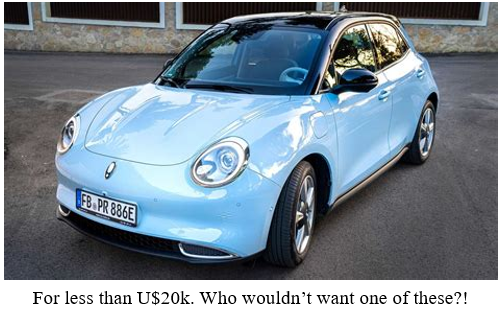
These qualities/advantages more than anything else is why Chinese EVs are doing well. Clack about government subsidies and unfair practices is a loser-smoke-screen put up by legacy manufacturers and political friends who’ve been badly caught off guard, IMHO.
You can read the paper in full via the following link Behind the EV Successes of BYD, Geely, and Xiaomi.
Happy Sunday.