Larry D. Qiu, Heiwai Tang, and Xing Wei from Lingnan U. (HK), HK U. and Nanjing U. have produced a novel little paper on the long-term benefits of having been a ‘Treaty Port’.
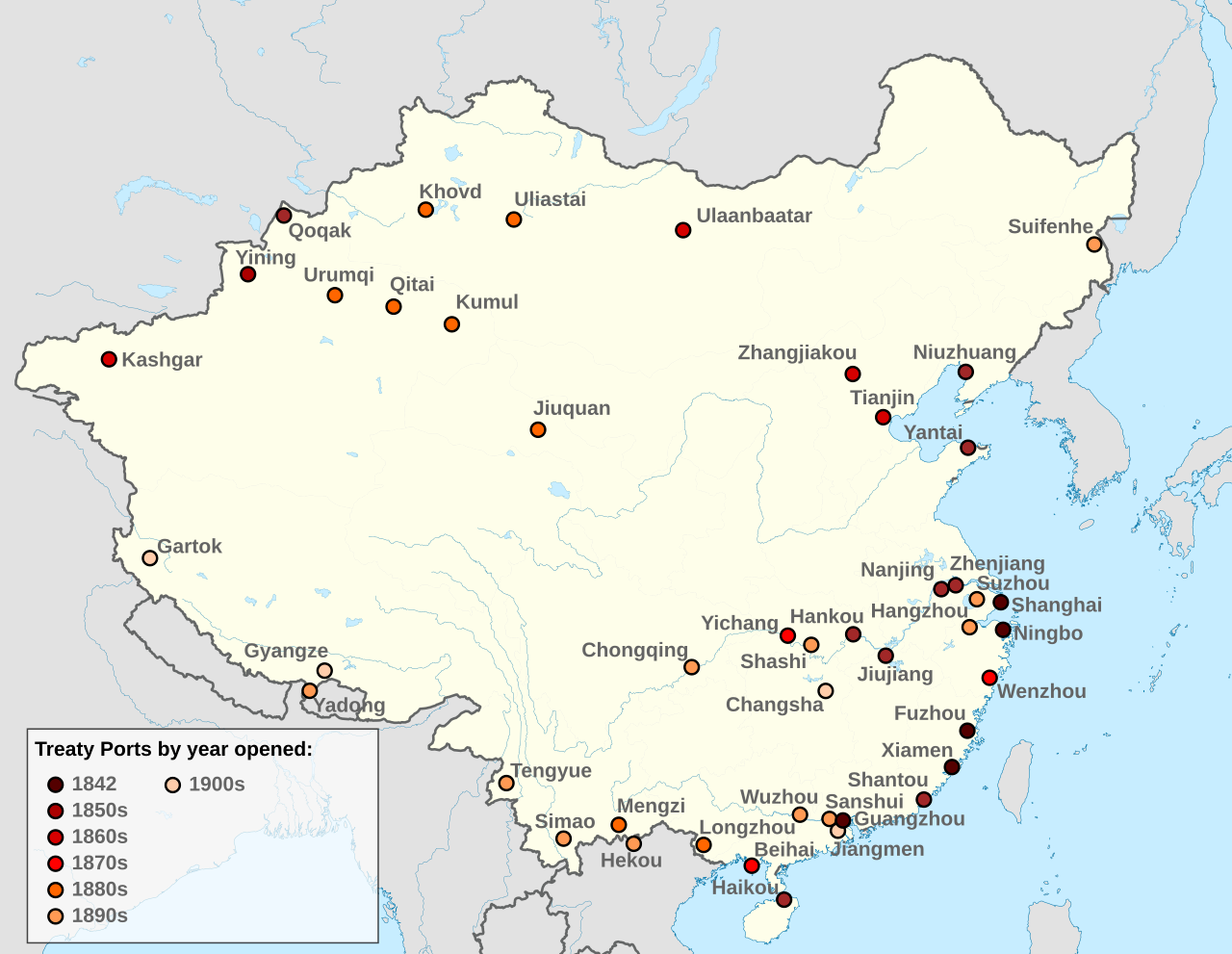
As the map reminds, there were a lot of these. You can find a list of the majors, and whose was whose here.
This is a short piece with a simple conclusion. Although the Treaty Ports ceased to operate as such at the end of WWII the effects of having been one are tangible today in terms of having more vibrant economies than peer locales.
Why should this be so? The paper suggests two main reasons:
The first is the persistence of foreign linkages. Even after the Liberation in 1949 enough residual contact remained between Treaty Ports and the ROW that when things improved from the late ’70s these connections retained a value that could be worked up into something more useful.
The second is firm risk preference. The Treaty Ports were effectively risk-management engines in more troubled times and a certain comfort with risk persisted whose embers could be coaxed back to life when conditions for risk taking became more accommodating.
The researchers go out of their way to isolate the characteristics particularly associated with Treaty Port status but I wonder if they haven’t just noticed something that was there before the Ports were established? Why, after all, would any foreign power waste its time with a city that it thought didn’t have some natural advantage for the progress of trade in the first place?
The bottom line is just as in life where advantage is persistent; money, influence, connections or all of them a town or city that’s been prosperous will for very long periods of time stay that way [And dogs, at least as far as geographies are concerned, will always be mutts?].
You can read the work in full via the following link Treaty ports and firm export in China.
Happy Sunday.