Ralph Ossa and Stephen Redding from the Zurich and Stanford universities writing in a National Bureau of Economic Research (NBER) Working Paper get straight to the point:
“Empirical findings from the recent waves of U.S. tariffs suggest that most of the incidence of these tariffs has been borne by U.S. importers, wholesalers, retailers and consumers rather than by foreign exporters. These tariffs have led to a large-scale reorganization of U.S. supply chains away from China to third countries. Although this reorganization has substantially reduced China’s share of U.S. imports, the U.S. remains indirectly exposed to China through the imports of these third countries.”
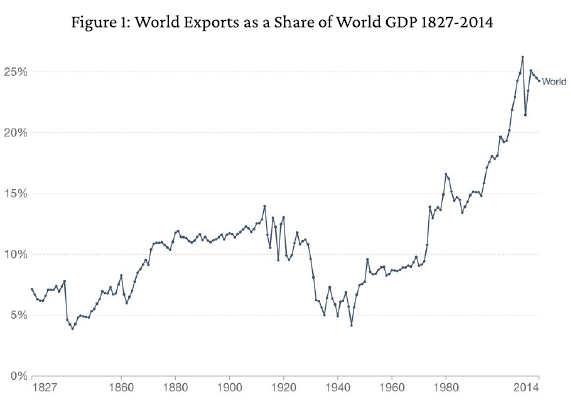
The paper begins by reminding us of how ‘global’ our world has become since the conclusion of WWII.
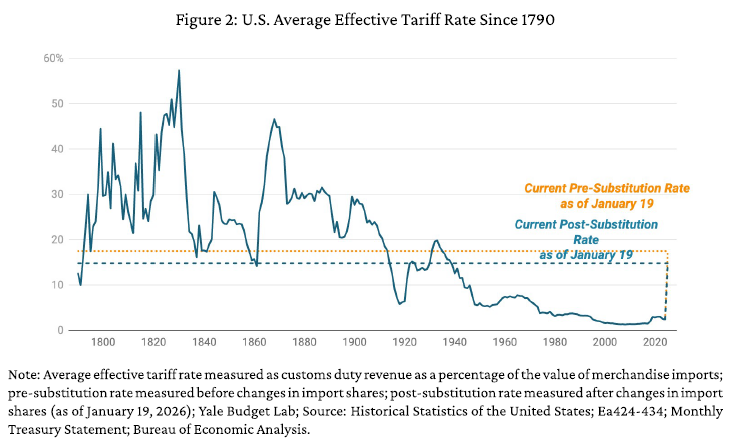
..and how this been achieved in the context of almost continuous tariff reductions, until comparatively recently.
The paper then gets into involved discussions the authors believe are necessary as academics are out of practice on tariff for-or-against arguments.
One key point, accessible to lay readers, is to understand international trade as being the equivalent of a productivity enhancing technology. Benefits will necessarily be unevenly distributed but nobody would imagine prosperity, locally or globally, could be improved by taxing technology; which is what tariffs, de facto, end up doing.
Another useful observation is that the evidence of tariffs in the U.S. leading to higher prices for consumers is patchy. They find, as other studies have also concluded, that a great deal of ‘absorption’ has gone on by importers and retailers thus shielding U.S. consumers from wide ranging price rises as a direct result of tariff introduction [For now? Ed.].
The paper wraps up noting not ALL tariffs are a bad idea, in certain circumstances and in certain cases selectively applied they can be effective. However in nearly ALL of these cases better targeted interventions, subsidies for fledgling industries for example, would be more effective.
There’s selective access to the paper in full at the NBER website here The Economics of Tariffs but if you find that’s blocked I have copy I can send, ping me at nial@nialgooding.com.
Happy Sunday.