Researchers Hanming Fang and Chang Liu writing in a Working Paper for the U.S. based National Bureau of Economic Research take a novel look at a piece of the global issue of falling births. In this case it’s the Chinasphere or what’s more often more euphemistically referred to as ‘East Asia’.
The researchers wanted to dig deeper into the notion that as ‘Confucian’ societies one would expect the maintenance of robust family infrastructure in that part of the world to have some extent mitigated the global trend for having less children; but it hasn’t.
Their explanation is intriguing. They begin by highlighting two important strands of Confucian philosophy, the need to protect a family line by bringing sons into the world and the need to educate progeny.
Historically both these inclinations had manifest beneficial societal consequences, but in the modern world they clash with the greater emphasis on education ending up reducing fertility.
The global trend seems to have bitten harder in East Asia.
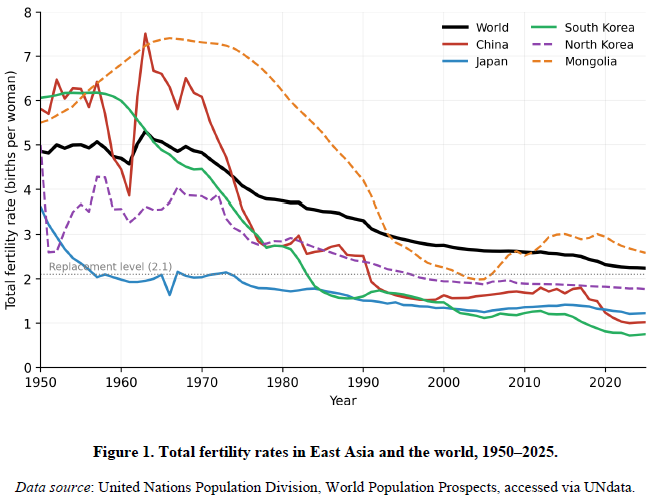
The problem in brief, starting with the family shrinkage issue.
The authors argue that the modern world has reduced infant mortality, raised incomes, allowed women to participate more fully in the workforce and state pensions have to a large extent removed the worry of poverty in old age. These factors occur elsewhere in the world and are almost certainly there too bearing down on fertility.
What’s different in East Asia is the Confucian emphasis on education, meritocratic achievement and the social benefits that accrue from getting ahead of peers in this regard. To progress these benefits now require private tutoring, helicopter parenting, achievement in one-off high stakes entrance exams and a financial and psychological ‘cost’ parents can’t spread across multiple offspring.
The researchers argue these two strains of Confucianism end up being accelerators, one for the other, in this process.
The paper ends up noting East Asian habits appear to be spreading. Most are familiar in the West with the concept of ‘Tiger Moms’ and they suggest that the structure of education there, moving more to a winner-take-all model, may be a part of the equation.
What’s clear is that present policies being reached for by governments to reverse this trend aren’t working and that should make this a discussion that broadens out to encompass reward and education systems that appear to be a root-problem-cause worldwide.
The paper has a lot more interesting detail and you can access it via this link Education Competition and Ultra-Low Fertility in East Asia.
Happy Sunday.