In a CESifo Working Paper authored by Harald Fadinger (et al.) of the University of Vienna the researchers present the most comprehensive study (I’ve seen) to date on the effects of China’s tariffs on the U.S. and vice versa with particular emphasis on the effects on third countries.
Their work covers ‘millions of establishments’ in 50-countries and looks in granular detail at 200,000 Multi National Enterprises (MNEs) between the period 2018~2022. First, a quick reminder of what happened..
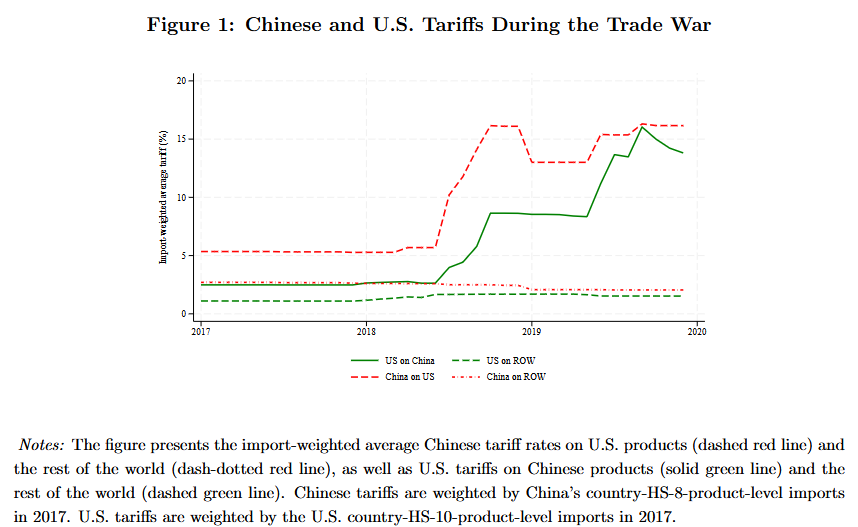
If you recall the numbers were unprecedented in their historic scale and all manner of calamity, for everybody was forecast. Well, we now know what, in fact, happened next. The paper’s main findings are as follows:
- Third country effects were highly heterogeneous i.e. they varied. There was no one-size-fits-all response. The net effect of all the tariff sturm-und-drang, on the world as a whole, was minimal. It might have been slightly negative.
- 70% of global trade takes place within global value chains of 2/3 of global trade is accounted for by Multi National Enterprises (MNEs). Considerable shifting around of production was noted among these MNEs. Domestic firms didn’t respond to the same extent.
- Of all MNEs, unsurprisingly, China’s were the most active. The shift of activity out of China (by them and other non-Chinese MNEs) did have beneficial employment consequences for some third countries.
I’m going to tip in my own observation here, which became clear almost from day-one of the Tariff-Tantrums. Tariffs are a 19th century solution to 21st Century problems and thus doomed to fail.
Among the biggest of these 21st Century problems, IMHO, is a failure of Western governments to educate populations on the necessity of moving to where there are better opportunities and fostering policies that make this easier. At the same time education systems need overhauling to better prepare work-forces for a world where brains (or brain-related industries), not brawn determine lifetime economic outcomes.
If you’d like to review the paper in full you’ll find it via the following link The U.S.–China Trade War and the Geography of Global Production.
Happy Sunday.