Seth G. Benzell, Laurence J. Kotlikoff, and Victor Yifan Ye writing in a Working Paper for non-profit think tank the National Bureau of Economic Research (NBER) have produced intriguing ‘what-if’ analysis of global trends to 2100 if demographic and technology trends persist.
If you wish to get into the weeds of this you can access the paper via the following link The Global Transition or, if that doesn’t work (there’s limited NBER access) let me know and I can share my copy with you.
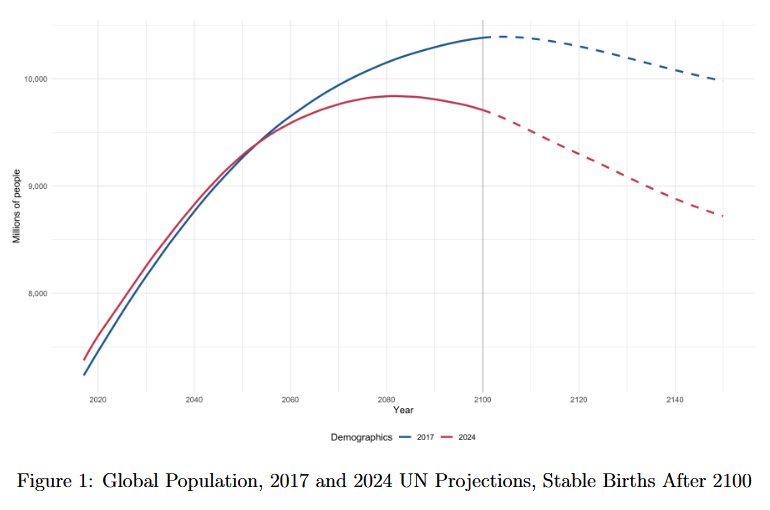
This chart shows how UN population projections altered between 2017 and 2024 and highlights the level of imprecision implicit with this sort of work.
Caveats aside, from this come some seriously shocking numbers. For example, if these trends persist Korea’s population will fall by 57% between now and 2100; China’s will more than halve.
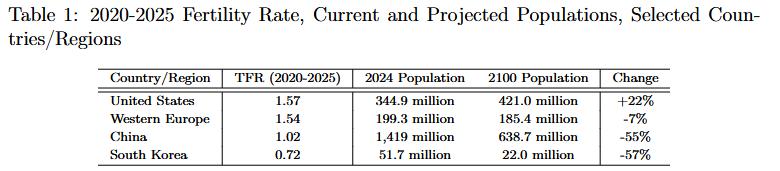
The United States will have a better time of it than almost anywhere else in the world due to an all-important saving-grace, immigration.
There’s a lot of ‘on the one hand, but on the other’ in the paper so I’ll just summarize some of the more important projections below:
- China’s 2100 share of global GDP will fall from 25.6% to 14.9%.
- The U.S.’s share of global GDP will rise to 14.4%, almost parity with China.
- Productivity per worker over the period makes no headway. The U.S. gains by having more workers.
- A capital glut reduces returns. The real return to capital which was 5.9% in 2017 falls in 2100 to 1.9%.
- Sub-Saharan Africa’s population rises but their living standards fall due to an inability to source capital and deploy frontier technology.
- Taxes, as a percentage of wages rise all over the world. Europe is particularly badly hit but the effect is less keenly felt in the U.S.
The biggest zinger’s at the end:
“Our paper delivers two negative messages to those predicting the 21st Century belongs to China. First, given the latest UN demographic forecast, the Chinese and US economies will be of roughly equal size throughout the century. This assumes, however, a robust US rate of immigration, which current immigration policy calls into question. Second, if the UN’s 2024 demographic projections hold and AU/AI proceeds at the extremely rapid pace predicted by many, US GDP will substantially exceed Chinese GDP throughout this century and, likely, the next.”
Perhaps China should start to love immigration a bit more?
Happy Sunday.