Why did the Roman Empire collapse? Why did the Industrial Revolution begin in Great Britain? Why, from the early eighteenth century, did Europe progress farther and faster scientifically than China despite China’s starting advantage? There are many theories, probably no single answers and the issues will most likely never be resolved.
The paper highlighted today though using new techniques adds a dimension of understanding to the last question. Why? From 1700 or so did European and Chinese progress diverge so starkly?
Maoran Lin and Chicheng Ma at the University of Hong Kong went back to the root of the European Industrial Enlightenment where Sir Francis Bacon (1561~1626) sits. ‘Baconism’ was cited by many of the great scientists of the 18th and 19th century as underpinning their methods.
In a nutshell Bacon noted that study of past genius would not allow progress beyond their achievement. He also managed to neatly fold scientific discovery into the religious orthodoxy of his day thus de-fanging ecclesiastical opposition to scientific progress (at least in England at the time). He also set out methodologies we regard as standard today but at the time were unheard of such as the starting hypothesis and the importance of empiricism to substantiate argument.
The researchers fed Bacon’s most important written works into their model and then did the same for 41,797 articles by Chinese scholars from the period 1650~1940 to see if and where there might be convergence.
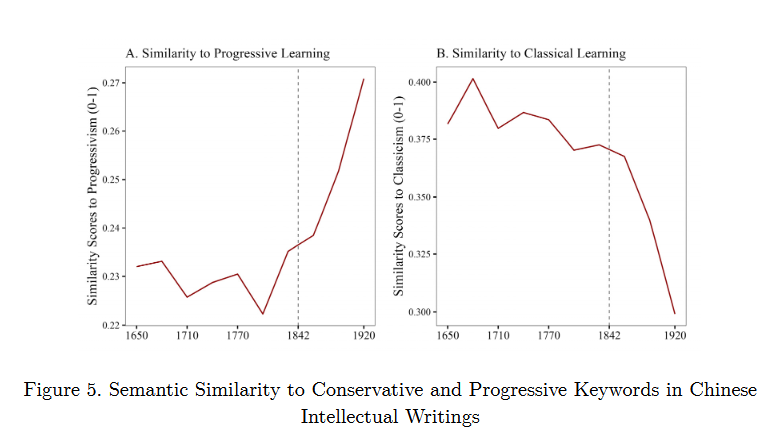
The pattern is stark. Chinese scholars continued to focus on classical learning i.e. the past genius that Baconism stressed you had to go beyond, until 1842. From that time China was prized open by foreign powers starting with it’s defeat of the First Opium War and the focus of learning changed. Too late as we now know for China to avoid the wider occupation and expropriation by colonial powers that followed.
The paper makes the point that although Chinese scholars didn’t develop their own Baconism as soon as they became exposed to the ideas that were coming in after 1842, and for the many who traveled outside China, there was no cultural impediment to taking these ideas and methods on board.
You can read the paper in full via this link Distance to Bacon
Happy Sunday.