When and why has Europe gone so wrong; and what, if anything, can be done about it? These are the issues the trio responsible for today’s paper, from the London School of Economics, the Massachusetts Institute of Technology and the European University Institute, take a closer look at.
When did Europe go wrong? Seems to have been around 1980.
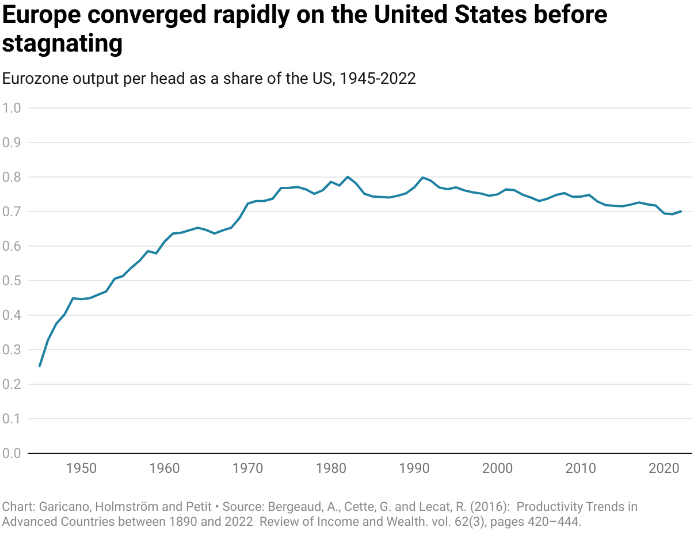
Why has it gone wrong? The root cause of Europe’s problems has been a shift in focus away from integration and increasing prosperity. Instead a confused agenda, associated with a legislative impulse, has taken hold. Viz., “The European Union currently pursues a long list of goals, including (as given by the Commissioner titles): promoting the ‘European way of life,’ ‘health and animal welfare’, ‘environment, water resilience and a competitive circular economy’, ‘intergenerational fairness, youth, culture and sport’ or ‘social rights and skills, quality jobs and preparedness’.”
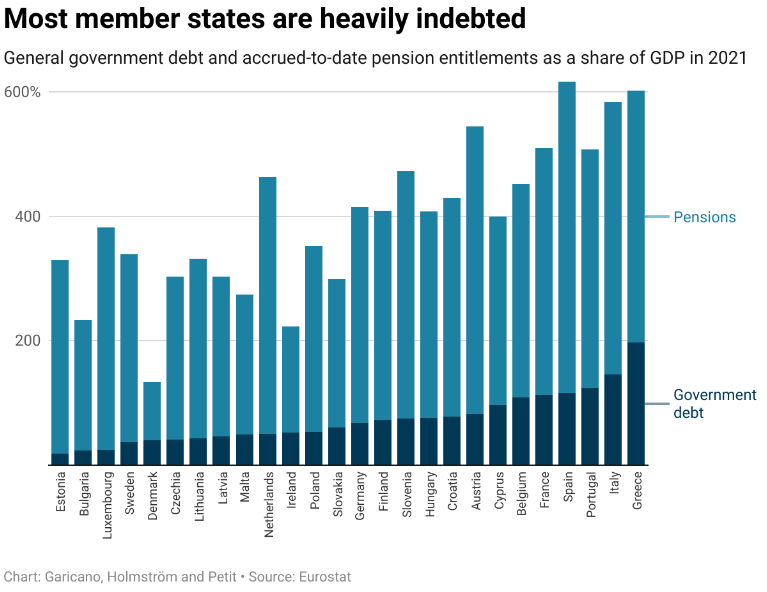
Which brings us to the other big problem. Think China has a debt problem? Ha!
The fix? “A much better Europe is feasible if it stops building walls of regulation, lets innovation happen, and focuses on prosperity above all else.” A fine sentiment, but how to achieve this?
The analysts have a six point plan:
- Eliminate ‘directives’. These are the mechanism that continues to prevent one size fits all standards. Common standards should be that without the addition of directives making country by country special case arguments.
- Establish specialized commercial courts. These would rule on trading violations and enforce the standards referred to above.
- Federal field preemption. When ‘Europe’ rules on a business practice this should be the bloc-norm and supersede local regulation.
- Create a ’28th Regime’. A rule book that all 27-members agree to abide by. Forget trying to harmonize 27 systems. Work out a single new one. Companies that want to stay with local regulations can but those that don’t can go into this system and instantly operate bloc wide.
- Rely on existing institutions where possible. Europe does some things well. Where excellence is in operation make it the Euro-norm.
- Reform legislative practices. Of course! Make them faster, more accountable and present cost benefit analysis for all new proposals.
The paper concludes:“In trying to do everything, we have hindered innovation, investment, and prosperity.” and “The constitution of innovation we propose offers a different path, built on limited objectives, clear rules, and strong enforcement. This constitution does not require a new treaty. It requires will”
You can read the piece in full via this link The Constitution of Innovation: A New European Renaissance. I wonder what the researcher’s true purpose in creating this document was? They call their proposals ‘practical’ but they seem to me anything but.
Europe’s problems stem, in my view, from deeply embedded (and getting worse) nationalism, a corrosive legacy-superiority-complex, a disdain by established elites for money making and a refusal to pursue a truly integrationist agenda. Just one example:
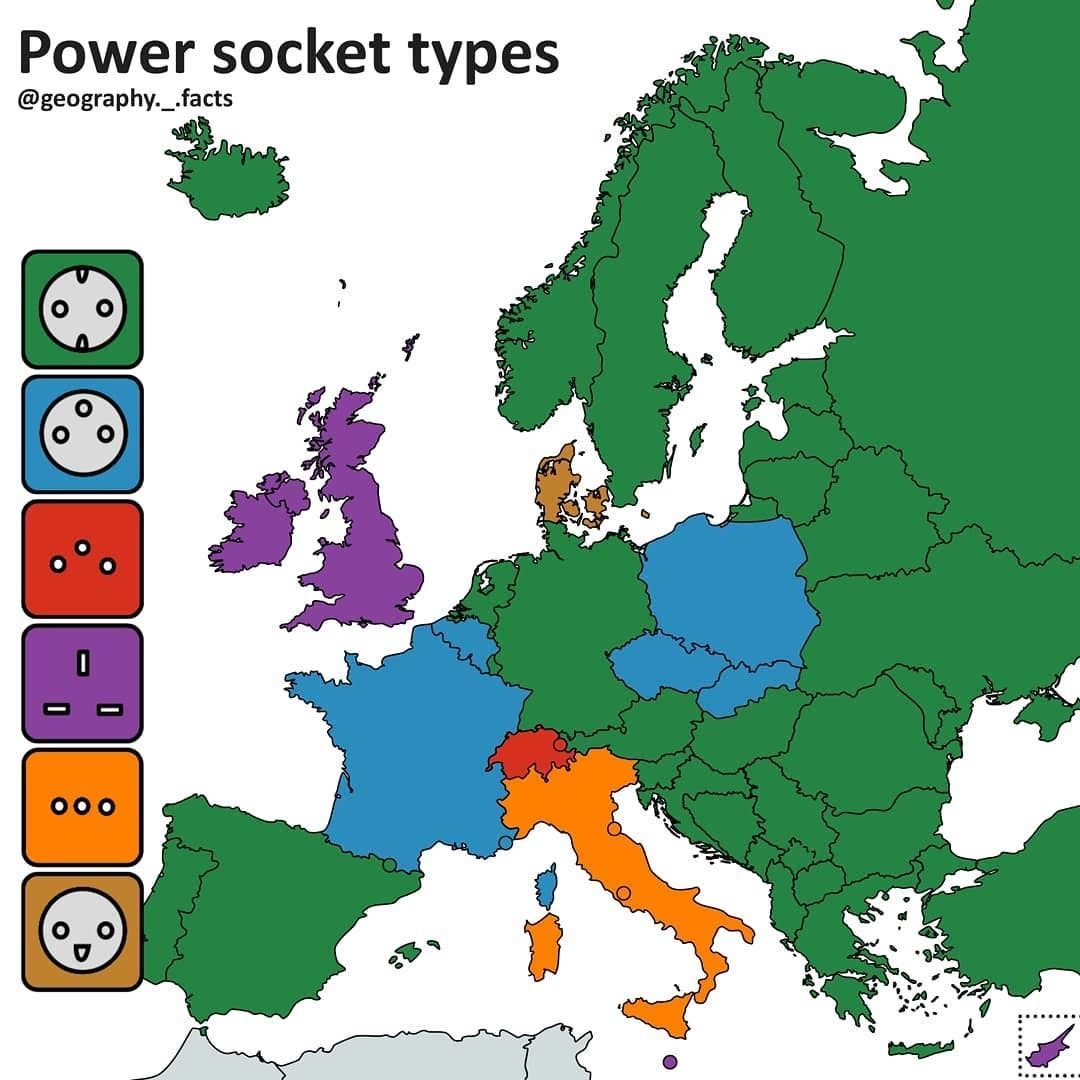
How about you fix this mess for starters. Then, adopt a common official language (there’s only one choice really), balance your budgets, adopt a common financial strategy, integrate your military assets and, tomorrow preferably, adopt common standards, for everything.
I know none of this possible so I know Europe is doomed to being nothing more than an ever closer union of magnificent holiday destinations.
Somebody should tell the younger members, the only future for the ambitious is to go West, or East.
Happy Sunday.
[Yours, A. Happy European (who went East).]